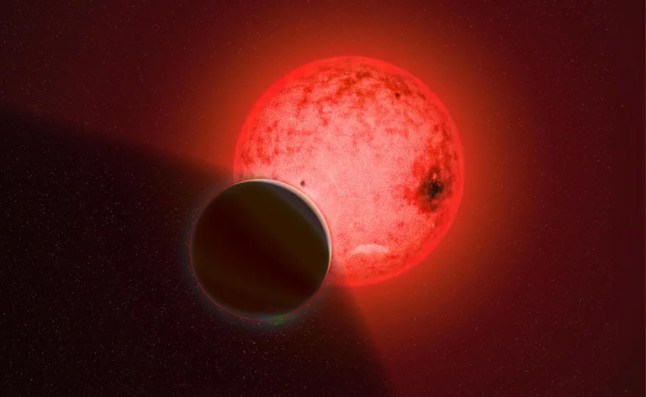
An artist’s conception of the gas giant planet TOI-5205 b orbiting a small,cool red dwarf star (Picture: Katherine Cain/Carnegie Science/Cover Media)
Astronomers have discovered a unique ‘forbidden’ giant planet that is not much smaller than its star.
The planet,TOI-5205 b,has been studied using the James Webb Space Telescope (JWST).
Researchers say the findings could reshape understanding of how such worlds develop in the early life of a star.
The study,published this week in The Astronomical Journal,was led by Caleb Cañas of NASA Goddard Space Flight Center and included Shubham Kanodia of Carnegie Science.
TOI-5205 b is roughly the size of Jupiter but orbits a comparatively small,cool star.
Such systems are sometimes described as ‘forbidden’ because current theories struggle to explain how such large planets can form so close to low-mass stars.
Sign up for all of the latest stories
Start your day informed with Metro's
News Updates newsletter or get
Breaking News alerts the moment it happens.When the planet passes in front of its host star – an event known as a transit – it blocks about 6% of the star’s light. By analysing this light with spectrographs,astronomers can determine the chemical composition of the planet’s atmosphere.Observations of three transits revealed a surprising result.The team found that the planet’s atmosphere contains a lower concentration of heavy elements – known as ‘metallicity’ in astronomy – than both Jupiter and its own host star.This makes it unlike any giant planet studied so far.Methane and hydrogen sulphide were also detected in the atmosphere,though these findings were less unexpected.
To better understand the results,researchers used computer models to estimate the planet’s internal composition.These suggested the planet as a whole may be far richer in heavy elements than its outer atmosphere indicates.‘We observed much lower metallicity than our models predicted for the planet’s bulk composition,which is calculated from measurements of a planet’s mass and radius.‘This suggests that its heavy elements migrated inward during formation and now its interior and atmosphere are not mixing,” Kanodia explained.‘In summary,these results suggest a very carbon-rich,oxygen-poor planetary atmosphere.’Planets form from discs of gas and dust that surround young stars. While giant planets are thought to emerge from these discs,systems like TOI-5205 b challenge existing models.The research forms part of the ‘Red Dwarfs and the Seven Giants’ programme,which is using JWST to study similar systems — sometimes referred to as GEMS,or giant exoplanets around M-dwarf stars.